



It’s not a statistic you would hear being thrown around at a party, but the global hospital furniture market is projected to reach $16.1 billion by 2030, up from roughly $8.2 billion in recent years.
Much of that growth is concentrated in commodity products: basic examination couches, standardised hospital beds, and generic treatment surfaces manufactured at scale in Asia. Within that market sits a smaller category that will be the focus of this article: treatment tables.
For manual therapy practitioners (physiotherapists, chiropractors, osteopaths, massage therapists, and an expanding range of allied health professionals), the treatment table is their primary tool. They spend more time using it than anything else.
Strangely enough, the gap between what’s commercially available and what practitioners actually need in a busy modern clinic is pretty wide. However, the gap has started to close over the past 5 or 6 years. Here is where the innovation is happening, and where it still falls short.
The Actuator Question
Electric height adjustment has moved from luxury to baseline expectation in most clinical settings. Very few practitioners (except the ones trying their hardest to save a few dollars) will accept a manually adjusted table in 2026. But the things an electric table can do compared to a manual table are substantial, and they make a huge difference to a professional.
Speed, force, and duty cycle (how many adjustments before it needs to cool down) are the critical metrics. A German-engineered actuator producing 10,000N of lift force at 37mm per second will traverse a full 487mm height range in approximately 13 seconds (very quick!). A budget alternative might take 30 seconds or more for the same range, and struggle under bariatric patients.
For a clinic that sees dozens of patients each day the table might be running 30 or more table adjustments per day which adds up. Slower adjustments usually boils down to fewer different treatments during a session. Or in a real-world setting, practitioners having to wait on their equipment rather than treating their patients.

Duty cycle is the metric most often overlooked at the procurement stage. An actuator’s duty cycle determines how many consecutive operations it can perform before requiring a cooling period. In a clinic where tables are adjusted between every patient (and often multiple times during a single appointment for position changes), a low duty-cycle actuator will intermittently stop responding. The practitioner presses the foot pedal and nothing happens. This is more than an inconvenience; it disrupts clinical workflow and erodes the practitioner’s confidence in the equipment.
At Alevo, we’ve built our Pro-Lift range of electric tables around German actuators rated for sustained clinical use. But the principle applies regardless of manufacturer: when evaluating treatment tables, the actuator specification should be the first conversation, not an afterthought. Ask for the lift force in newtons, the speed in millimetres per second, the duty cycle rating, and the speed under load (not just unloaded). These numbers tell you more about the table’s clinical suitability than any brochure photograph.
Modular Design for Multi-discipline Practices
The traditional model of a single-discipline clinic is giving way to multi-discipline practices. A growing number of facilities house physiotherapists, osteopaths, remedial massage therapists, and beauty or aesthetic practitioners under one roof. This consolidation is driven by commercial reality: shared reception staff, shared lease costs, and the ability to refer patients internally across modalities.
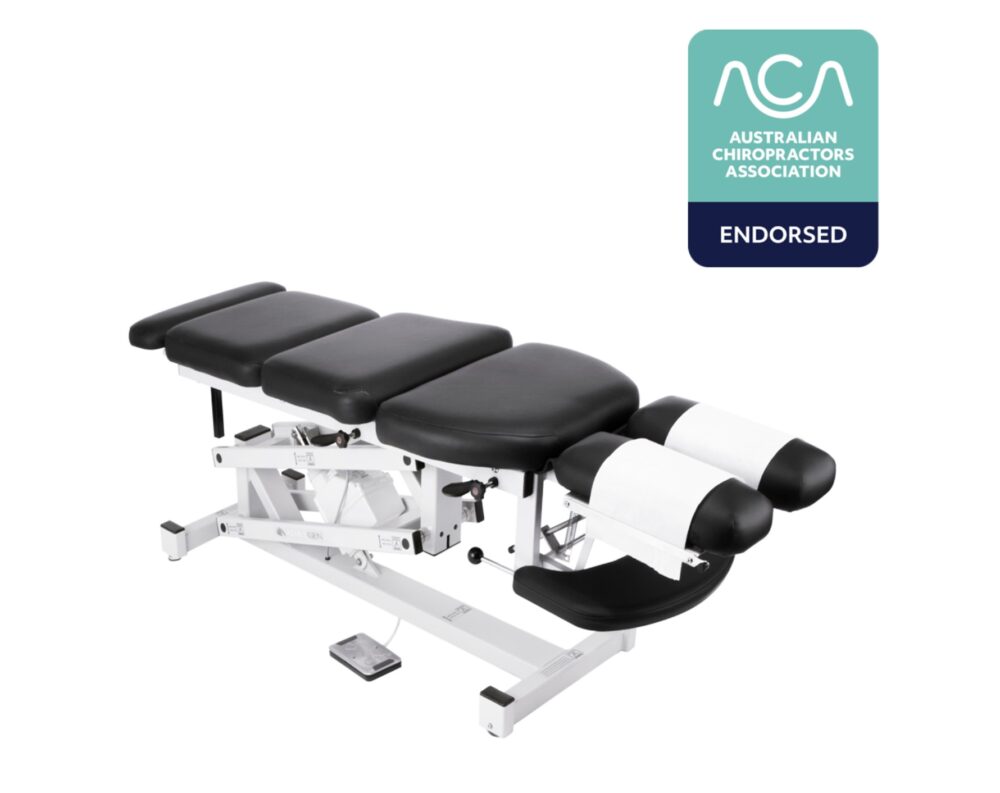
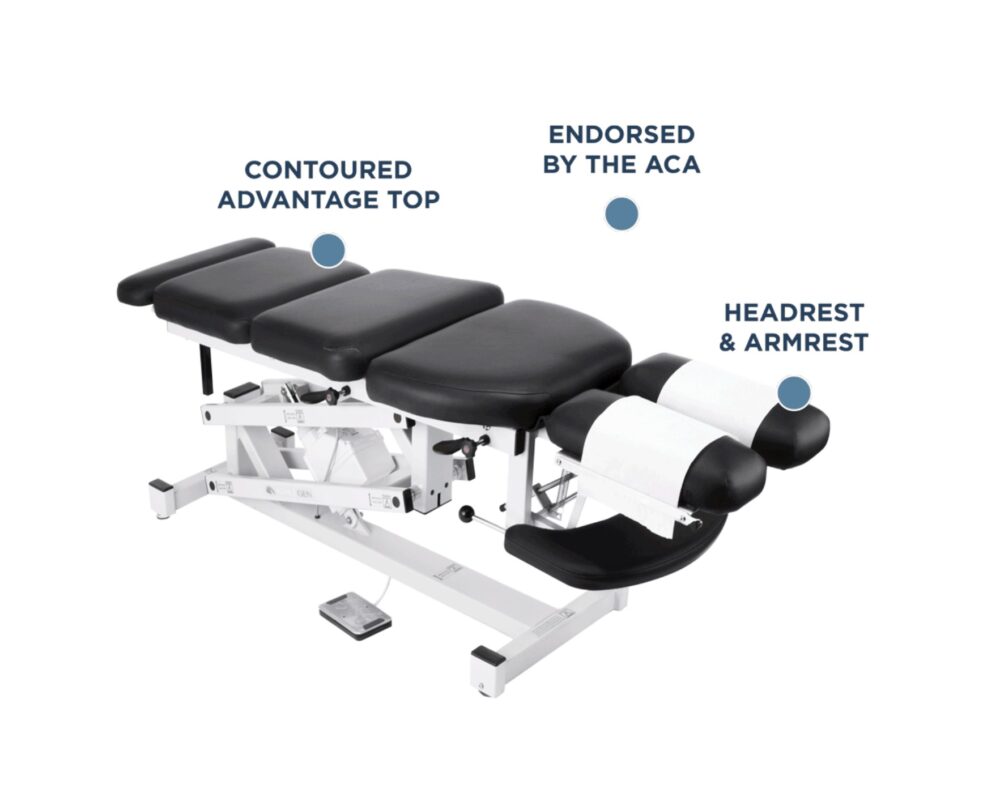
Each modality has different requirements from its treatment surface. A chiropractor performing spinal adjustments needs magnetic drop sections and ultra-firm cushioning (50mm or less, minimal compression). A beauty therapist needs a table that converts from a reclining chair to a flat surface, with luxurious memory foam cushioning (80mm) that signals comfort to the patient. A physiotherapist working with post-surgical patients needs a wide height range, a motorised backrest for seated treatments, and medium-firm cushioning that supports assessment positions. A podiatrist needs a chair that tilts the leg section to near-vertical. Fit out a multi-discipline practice with a single generic table model and someone is always compromising.
This creates a procurement question: standardise on one model (simpler to manage, cheaper per unit) or invest in modality-specific treatment table that match each practitioner’s workflow?
In three decades of manufacturing treatment tables, the feedback I’ve received points consistently in one direction. Practitioners prefer purpose-designed equipment. A chiropractor will adjust their technique around a generic table, but they’ll perform measurably better on one designed for their discipline. The same applies across modalities. The cost premium for specialisation is typically 10-20%, but the performance and satisfaction gains are disproportionate. Clinics that have switched to modality-specific tables consistently report that practitioners resist going back to generic equipment, even when relocating to a new site where only generic tables are available.
Cushioning: More Than Comfort
Cushioning is often treated as a secondary consideration during procurement, something selected from a dropdown menu after the frame and actuator decisions have been made. This underestimates its clinical importance.
The foam system affects patient positioning stability (critical during spinal manipulation and soft tissue assessment), perceived treatment quality (patients associate cushioning firmness with professionalism), and the table’s functional lifespan. A foam system that compresses permanently after 12 months of clinical use effectively degrades the table’s utility even while its frame and actuator remain functional.
Premium cushioning systems now offer multiple density tiers to match clinical requirements. Ultra-firm options (50mm) suit chiropractic adjustments where the patient must remain stable on the surface during high-velocity manoeuvres. Standard medium-density foam (55mm) suits general physiotherapy and remedial massage. Slow-release memory foam (80mm) suits spa and beauty applications where patient comfort is the primary design criterion. The material science behind these systems has advanced considerably: modern closed-cell foams resist moisture penetration, maintain their recovery characteristics over thousands of compression cycles, and comply with flammability standards required in clinical environments.
Procurement decisions that treat cushioning as an afterthought tend to generate replacement costs within 18 months. Specifying the correct foam density for the intended clinical application at the outset avoids this.
Infection Control as a Design Constraint
The pandemic permanently raised infection control expectations in clinical environments. What was once a concern primarily for hospital settings has become a baseline requirement across all clinical practice.
Treatment tables are high-contact surfaces that must be cleaned between every patient, often with aggressive disinfectants. Seams in upholstery trap bacteria. Porous foam absorbs contaminants if the vinyl surface is compromised. Bases with complex geometries are difficult to wipe down between appointments.
Manufacturers have responded with seamless welded upholstery, antimicrobial vinyl compounds compliant with standards like AS 1530.3 (covering flame resistance and material safety), and simplified base designs that can be cleaned in under a minute. Hospital-grade examination couches led the way here, but those standards are now migrating into allied health and wellness settings.
The practical test is straightforward: can a staff member clean the entire table, including the base, actuator housing, and all upholstered surfaces, in under 60 seconds with a standard clinical disinfectant wipe? If the answer is no, the table’s design is creating a bottleneck in the infection control workflow. In a clinic turning over patients every 30 to 45 minutes, every second spent on cleaning is a second not available for treatment or documentation. Equipment that simplifies cleaning doesn’t just reduce infection risk; it improves operational throughput.
Practitioner Ergonomics and Career Longevity
Musculoskeletal injury is one of the leading causes of early career exit among manual therapists. Repetitive bending, sustained awkward postures, and treating patients at suboptimal heights contribute to chronic back, shoulder, and wrist conditions. The World Health Organization identifies MSK disorders as the leading contributor to disability globally, and healthcare workers are disproportionately affected.
Consider the numbers. A practitioner who begins their career at 25 and treats an average of 10 patients per day, five days per week, will perform over 60,000 treatments by the time they reach 50. The cumulative ergonomic load is enormous. Every one of those treatments involves sustained postures, repetitive hand and wrist movements, and load bearing through the spine and shoulders.
A table with a height range from approximately 475mm (low enough for seated wheelchair transfers) to 960mm (high enough for a tall practitioner to work upright) allows adaptation across patient types and treatment techniques. Electric adjustment eliminates the physical strain of manual cranking between patients. A pneumatic foot pedal positioned at floor level means the practitioner never needs to interrupt their hand placement to adjust height mid-treatment.
This is not a marginal improvement. Research consistently links adjustable-height work surfaces with reduced MSK injury incidence across healthcare settings. Equipment that reduces bending, eliminates awkward reaches, and adjusts height at the touch of a foot pedal isn’t a comfort feature. It’s a career preservation tool. The practitioner who can still work comfortably and pain-free at 55 has a direct financial advantage over one who burns out at 40.
Durability in High-throughput Environments
A busy physiotherapy clinic running six days a week with twelve patients per table per day generates approximately 3,700 treatment sessions per year per table. Over a five-year equipment cycle, that’s nearly 19,000 sessions. Actuators, gas struts, and locking mechanisms must withstand this volume without failure, because a table out of service means lost revenue and disrupted patient schedules.
The frame itself faces different stresses. Repeated loading and unloading at different height positions tests weld integrity. Patients shifting weight during treatment creates lateral forces that cheap frames weren’t designed for. Castors must maintain their locking integrity after being unlocked and relocked thousands of times for room cleaning. These are not glamorous specifications, but they determine whether a table is still functionally sound in year eight or requires replacement in year three.
Warranty terms are a useful proxy for manufacturer confidence. A two or three-year warranty on the frame suggests the manufacturer expects problems within that horizon. A 15-year structural warranty, as Alevo offers on its Pro-Lift range, signals engineering designed for sustained clinical use. The same logic applies to cushioning: premium foam systems like Dunlop’s multi-density options maintain their support characteristics over thousands of hours, while commodity foam compresses and bottoms out within 18 months.
For procurement decisions, total cost of ownership over ten years is a more useful metric than purchase price. A table costing 40% more upfront but lasting three to five times longer is the more economical choice by a significant margin. When downtime costs, replacement logistics, and staff injury risk are factored in, the premium option is frequently the cheaper one.
Looking Ahead
The treatment table is not an ancillary purchase. For the practitioners who use it every day, it’s the centrepiece of their clinical environment.
As clinical practices become more sophisticated, as infection control standards tighten, and as practitioner retention becomes a strategic concern for clinic owners, the quality gap between purpose-engineered tables and commodity alternatives will only widen. The manufacturers who invest in actuator technology, modular design, medical-grade materials, and genuine long-term durability will define the next decade of clinical furniture.
The treatment table has been underspecified for too long. Practitioners deserve equipment that matches the sophistication of the treatments they deliver. The ones using purpose-engineered equipment will be the ones still practising comfortably at the end of a long career.
This article was written by Stephen Falkiner, CEO, Alevo