




At a New York press event, Global Wellness Summit leaders unveiled new research, media strategies, and design frameworks redefining wellness as a scientific, cultural, and economic force.
In a hurry? Here are the key points to know:
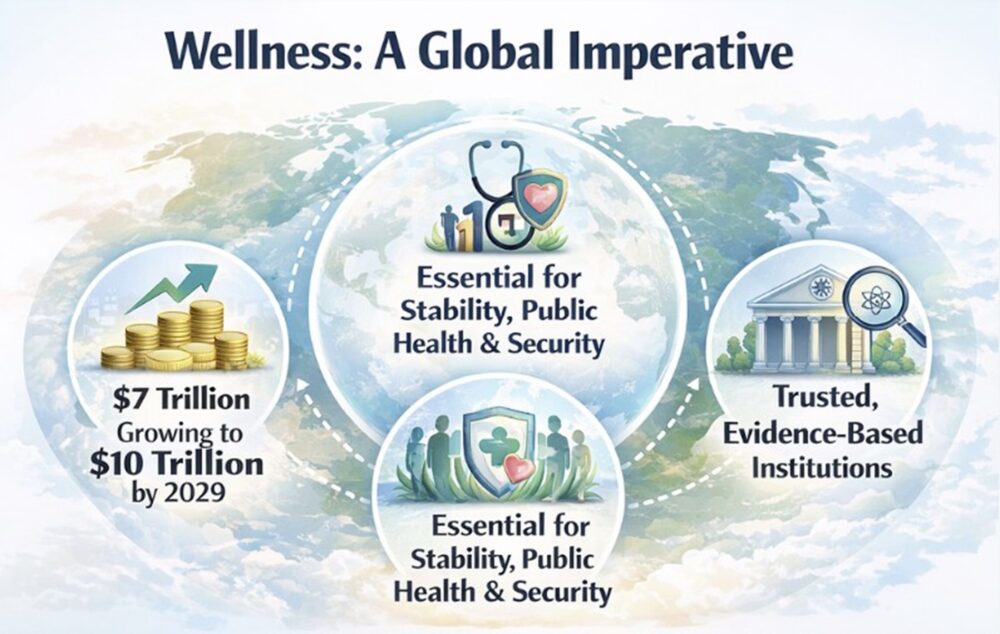
- Wellness is now: a $7 trillion global economy projected to reach $10 trillion by 2029.
- Investing in wellness is: essential for stability, public health, and global security.
- Trusted evidence-based institutions are: crucial for advancing science-backed wellness initiatives.
At a Global Wellness Summit press event in New York, leaders from public health, science, media, and policy gathered to deliver a clear message: wellness has moved beyond lifestyle discourse and into the realm of global leadership. What emerged was not a vision of wellness as self-care or consumer choice, but as a foundational system, one that shapes economic resilience, social trust, and geopolitical stability.
The event brought together major announcements, including the launch of the Intentional Spaces Roadmap, a continued collaboration between the Global Wellness Institute (GWI) and BBC StoryWorks, and new data underscoring the scale of the global wellness economy. Yet for medical professionals, the most consequential framing came from Dr. Richard Carmona, former U.S. Surgeon General, who positioned wellness as a prerequisite for peace, prosperity, and functional societies.
“Wellness in this context is not a luxury,” Carmona said. “It is a prerequisite for stability, prosperity, and peace.”
His remarks reframed wellness as a strategic lever for governments, healthcare systems, and global institutions—one that demands scientific rigor, cross-sector coordination, and public trust.
Wellness in the Public Eye: Leadership, Trust, and Global Health
Dr. Carmona’s address situated wellness at the intersection of public health, geopolitics, and civic trust. Drawing on decades of experience spanning military service, trauma surgery, law enforcement, and national health leadership, he argued that today’s global challenges—pandemics, climate stress, chronic disease, mental health crises, and misinformation—are fundamentally interconnected.
“These challenges do not respect borders,” he noted. “They demand leadership that is collaborative, credible, and trusted.”
For medical professionals, this framing resonates with lessons learned during recent global health emergencies. Scientific advancement alone is insufficient without public confidence in institutions, alignment across sectors, and evidence-based communication. Carmona emphasized that erosion of trust—between governments and citizens, between science and society—has become a central risk factor for population health.
He also placed wellness within a broader historical context, noting that periods of deep social division have often required shared cultural and ethical frameworks to restore cohesion. In this sense, wellness becomes both a clinical and civic concept: prevention over reaction, resilience over fragility, and long-term value over short-term gain.
Importantly, Carmona positioned wellness as inseparable from leadership. For policymakers and health systems alike, he argued, investing in wellness is not an aspirational goal but a strategic necessity, one that underpins workforce productivity, healthcare sustainability, and national security.
The Scale and Growth of the Global Wellness Economy
Backing this leadership argument with data, Carmona highlighted the extraordinary scale of the wellness economy, a sector that increasingly overlaps with healthcare delivery, public health infrastructure, and preventive medicine.
“The global wellness economy today stands at nearly $7 trillion and is projected to grow to almost $10 trillion by 2029,” he said.
For clinicians and health system leaders, this growth trajectory signals more than market expansion. It reflects a global shift toward prevention, longevity, and whole-person health, areas where medical expertise is essential to ensure scientific validity and ethical implementation.
Carmona underscored that the wellness economy’s significance lies not only in its size, but in its potential to redirect resources upstream—away from reactive, high-cost interventions and toward evidence-based prevention and resilience. In this context, wellness intersects with chronic disease management, mental health, aging populations, and health equity.
“If wellness were a country,” he noted, “it would already be one of the largest economies on Earth.”
Yet he cautioned against viewing wellness purely through an economic lens. Without scientific rigor and regulatory integrity, rapid growth risks being undermined by hype, fragmentation, and misinformation, concerns well familiar to medical professionals navigating an increasingly crowded health marketplace.
Trusting Evidence-Based Institutions
Central to Carmona’s message was the role of institutions capable of separating evidence from aspiration. He pointed to the Global Wellness Institute as a critical actor in this space, describing its work as essential to governments, investors, healthcare leaders, and global media.
“The importance of the Global Wellness Institute is that it brings credibility, rigor, and trust to a space often dominated by aspiration rather than evidence,” he said.
For over two decades, GWI and the Global Wellness Summit have convened leaders from more than 100 countries across public and private sectors. Their nonpartisan, evidence-informed approach has allowed them to function as what Carmona described as “ethical soft power”—influence built not on ideology, but on data, shared values, and trust.
From a medical perspective, this convening role matters. As wellness increasingly intersects with clinical care, built environments, technology, and community health, physicians and researchers need partners who prioritize scientific validation, transparency, and outcomes measurement.
Carmona reflected that during his tenure as U.S. Surgeon General, such an institution would have been invaluable. Today, he framed GWI’s role as uniquely suited to translating science into policy, aligning stakeholders, and fostering global cooperation around health.
Looking Ahead: Wellness by Design, by Default, for All
The overarching message from the Summit was clear: wellness must be preventive, inclusive, and systems-based. It must be designed into societies by default—not reserved for those with access or privilege.
For medical professionals, this signals a shift in how health leadership is defined. Clinical expertise remains essential, but it must now operate within broader ecosystems that include policy, design, economics, and culture.
As the Global Wellness Summit looks toward future convenings, the challenge will be ensuring that wellness’s rapid expansion is guided by evidence, ethics, and equity. If that challenge is met, wellness may prove not only a driver of better health outcomes but a stabilizing force in an increasingly complex world.