

![[Siemens Healthineers] Redefining MRI Imaging: Inside the Magnetom Flow Platform](/wp-content/uploads/sites/9/magnetom-flow-siemens-healthineers-4-1000x561.jpg)

At WHX—formerly Arab Health—this year, Siemens Healthineers showcased its medical imaging Magnetom Flow MRI platform, a system designed to redefine flexibility, sustainability, and efficiency in magnetic resonance imaging.
Rather than offering a single, fixed configuration, Flow is built as a customizable platform that allows healthcare providers to tailor the system precisely to their clinical, operational, and infrastructural needs.
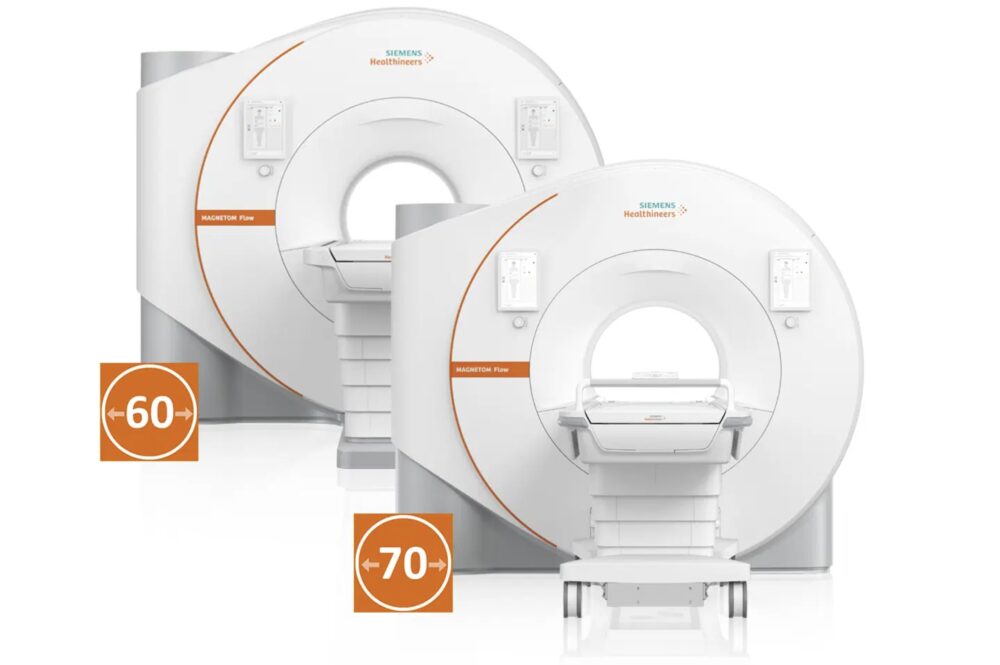
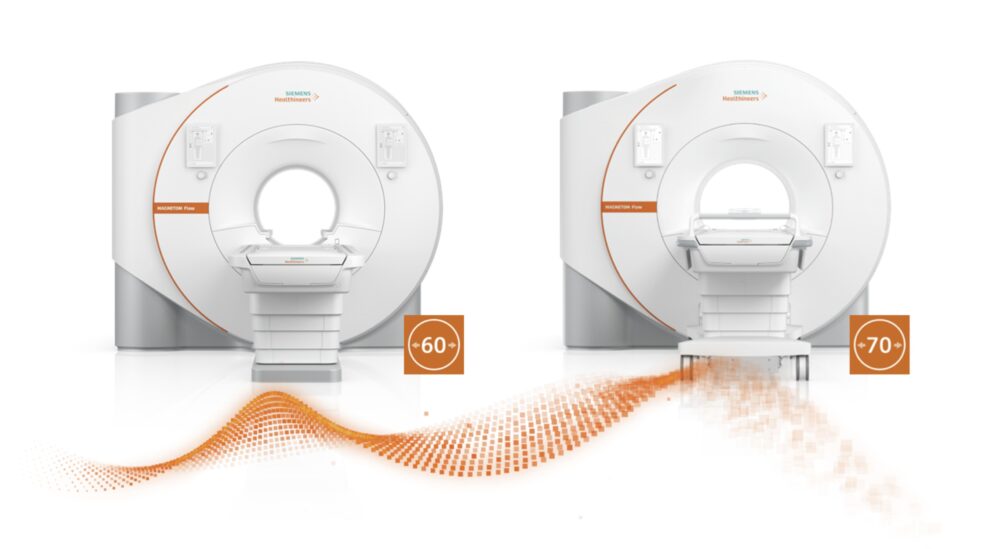
At its core, Flow is available in both 70-centimeter and 60-centimeter bore configurations. The 70-centimeter bore, now standard across many Western healthcare systems, improves patient comfort and accessibility, while the 60-centimeter version offers a compact footprint suitable for facilities with space constraints. This dual-option approach is what defines Flow.
“Flow is not just one system. It is a platform. It is available in different bore sizes, with different tables, gradients, and channel configurations. Customers can truly configure the system according to their needs,” said Anne Becker, Global Marketing Manager, during a product presentation.
Configuring the System for Specific Needs
Customization extends well beyond bore size. Customers can choose between fixed or mobile patient tables, allowing examinations to be prepared outside the scan room before smoothly moving the patient into position. This is particularly useful for patients arriving in metal wheelchairs or for facilities aiming to optimize workflow and patient throughput.
Another major area of customization lies in the gradient system, often described as the “engine” of the MRI. Multiple gradient configurations are available, enabling providers to balance performance, scan speed, and clinical application. Even coil selection, once bundled into standard packages regardless of usage, is now fully customizable. This shift responds to real-world feedback where many facilities found unused coils sitting idle on shelves. Flow allows users to select only the coils they actually need, improving efficiency and reducing waste
“For years, MRI systems were sold as fixed packages,” Becker explains. “But many customers realized they were paying for components they didn’t use. With Flow, the system adapts to the customer, not the other way around.”
Helium-Free Technology Expands MRI Reach
One of Flow’s most transformative features is its helium-free dry magnet technology. Traditional MRI scanners require hundreds or even thousands of liters of liquid helium to keep the magnet cold. In emergency situations, this helium can be lost during a quench, leading to long downtimes, high refill costs, and logistical challenges—especially in remote or underserved regions.
Flow requires just 0.7 liters of cooling material, eliminating dependency on large helium supplies without compromising performance.
“Helium is a finite resource, and access to it is not guaranteed everywhere,” says Becker. “By removing that dependency, we can install MRI systems in regions, hospitals, and environments where it simply wasn’t practical before.”
This shift is not only about sustainability, but also about reliability. Facilities no longer need to worry about helium delivery, quench recovery, or extended downtime, factors that have historically limited MRI deployment in rural areas, islands, and developing healthcare systems.
Helium-free technology also dramatically improves operational resilience. In traditional systems, a magnet quench can take an MRI offline for days while helium is replenished and the system is ramped back up.
With Flow’s dry magnet design, facilities can avoid this disruption entirely, ensuring continuity of care even in emergency scenarios or remote locations where helium delivery is complex or delayed.
“Helium-free technology is not just an engineering breakthrough,” Becker adds. “It’s a way to future-proof MRI, making it more accessible, more reliable, and more sustainable wherever healthcare is delivered.”

Compact, Energy-Efficient, and Upgradeable
Flow’s compact footprint further supports broader access. The system can be installed in approximately 25 square meters, including magnet, technical, and control rooms. Its lightweight design allows it to be rolled through standard hospital doors, reducing construction work, installation time, and environmental impact.
Energy efficiency is another key differentiator. Flow introduces Eco Power Mode, which dynamically adjusts cooling energy based on system activity. This reduces energy consumption by more than 30%, a critical advantage in regions with high electricity costs or unstable power grids.
“In some markets, sustainability even affects financing,” Becker adds. “Hospitals can qualify for green loans because they can demonstrate reduced energy consumption. That makes advanced imaging more accessible economically, not just technically.”
Flow is also designed to grow with customers. Unlike traditional MRI systems that require full replacement for upgrades, Flow allows in-generation upgrades. A facility can start with a smaller bore or lower gradient performance and later upgrade without removing the magnet from the room—extending system lifetime and protecting investment.

AI-Driven Automation Changes MRI Workflows
Artificial intelligence is another cornerstone of Flow’s mission to expand MRI access. Siemens Healthineers’ Deep Resolve technology uses neural networks to remove noise and enhance resolution, enabling dramatically faster scans without sacrificing image quality.
Exams that once took 15–20 minutes such as knee, brain, prostate, or cardiac scans can now be completed in just a few minutes. Faster imaging improves patient comfort, reduces motion artifacts and increases daily scanning capacity.
AI also simplifies operation through tools like My Exam Companion, which guides technologists through planning and execution. Complex decisions around slice angulation and anatomy recognition are handled automatically, with interfaces designed for both expert and non-expert users.
“With staff shortages worldwide, MRI systems must be easier to operate,” Becker explains. “Automation makes the technology more approachable and helps attract and retain staff.”
In some cases, facilities are already using remote operation models, where technical scanning tasks are managed centrally while on-site staff focus on patient positioning and care. This further expands access to MRI expertise across multiple locations.
“We are no longer just optimizing performance in existing environments,” Becker said. “We are actively redefining where MRI can exist and who can benefit from it.”