



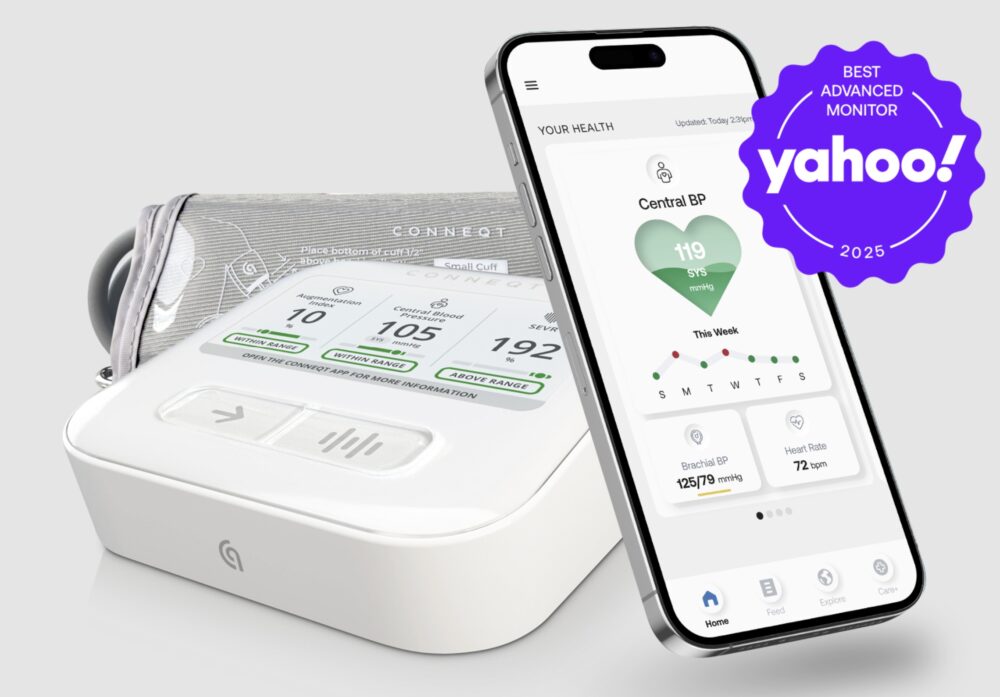
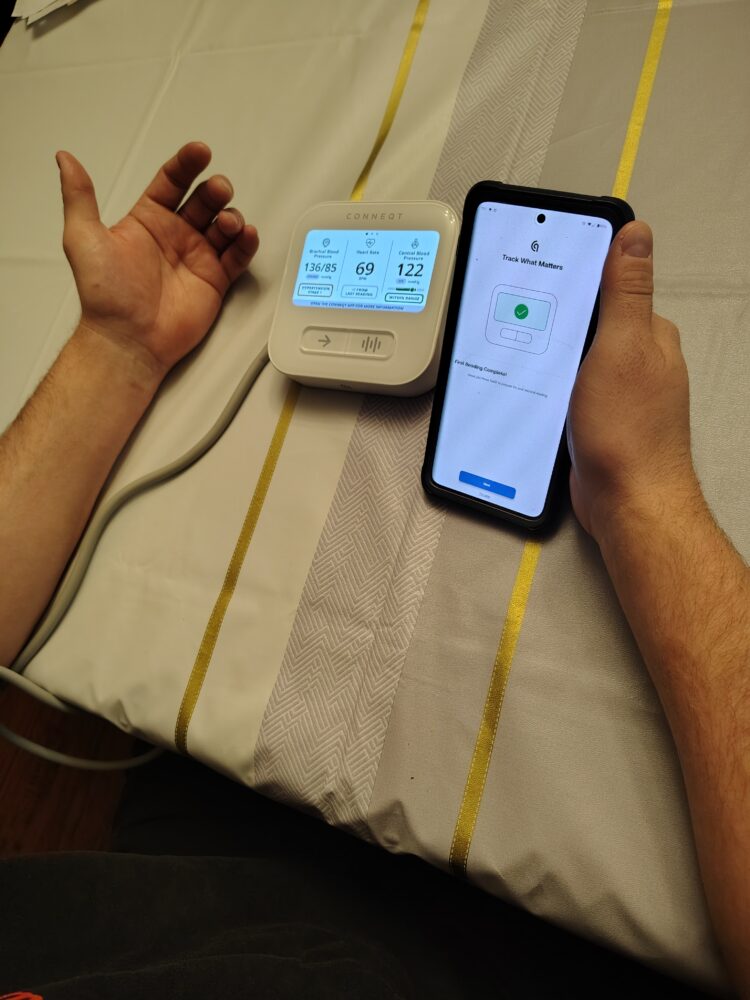
Following its 2023 FDA approval, the world’s first vascular biometric health monitor, CONNEQT Pulse, continues to show promise. We selected a user with a predisposition to high blood pressure and a strong family history of heart disease to test the device. Here’s what he wanted to know: what’s the difference between CONNEQT Pulse and a smartwatch?
In a hurry? Here are the key takeaways:
- Different data, different purpose: CONNEQT Pulse measures central blood pressure and vascular hemodynamics, while smartwatches track surface-level metrics like heart rate and activity.
- Clinical insight vs. convenience: The device requires active measurements but delivers deeper, clinically actionable data for cardiovascular risk assessment.
- Best suited for at-risk patients:Its value is greatest in hypertension management, family history of heart disease, and therapy monitoring—not general wellness tracking.
In 2023, the U.S. Food and Drug Administration granted 510(k) clearance to the CONNEQT Pulse by Cardiex Ltd. This marks the first approval of a wearable vascular biometric health monitor capable of delivering clinical-grade central hemodynamic measurements outside traditional care settings. For cardiovascular medicine, this milestone is not incremental. It represents a structural shift in how vascular risk may be assessed and managed.
For more than two decades, SphygmoCor® technology has served as the research gold standard for noninvasive central blood pressure, augmentation index, and pulse wave velocity measurement. It has supported over 2,700 peer-reviewed publications linking central hemodynamics to cardiovascular outcomes, target organ damage, cognition, and therapeutic response. Until now, however, this level of insight has remained largely confined to research laboratories, specialty clinics, and intensive care environments due to cost and complexity.
This matters in a country like the United States where nearly half of adult men have hypertension. Peripheral (brachial) cuff measurements, while indispensable, provide only a surrogate of the pressure experienced by the heart, brain, and kidneys. Central pressure, the true hemodynamic load, has historically required invasive catheterization or specialized equipment.
With CONNEQT Pulse, this technology has moved from the ICU and academic centers into a wearable and transportable format. At MedicalExpo e-Magazine, we set out to examine what this transition means in practice, both clinically and experientially.
Central pressure, the true hemodynamic load, has historically required invasive catheterization or specialized equipment.
WATCH this video interview with Craig Cooper, CEO of CONNEQT.
The Hidden Variable: Pulse Wave Amplification
In the podcast Beyond the Cuff: Unlocking Your Heart’s True Story with Central Blood Pressure, created by Chief Strategy & Commercial Officer Catherine Liao, we learn about a phenomenon long understood in vascular physiology but underutilized in everyday care: pulse-wave amplification.
As the pressure wave generated by cardiac ejection travels from the compliant aorta into smaller peripheral arteries, systolic pressure increases. The brachial reading obtained via cuff measurement is therefore not equivalent to central aortic pressure, with differences of up to 30–40 mmHg observed.
This distinction is not academic. Central pressure reflects the true workload on the left ventricle and the pulsatile stress imposed on cerebral and renal vasculature. Two patients with identical brachial readings (e.g., 130/80 mmHg) may have meaningfully different central pressures—and therefore different cardiovascular risk profiles.
The CAFE study demonstrated that even small differences in central pressure, undetected by peripheral measurements, can translate into meaningful differences in cardiovascular outcomes. The concept of “isolated central hypertension” further complicates traditional screening. A subset of patients may present with normal peripheral readings yet elevated central pressures, effectively masking risk under standard assessment models.
Over the past year and a half, central pressure monitoring has moved from theory to commercial availability. Importantly, emerging data suggest that central-guided therapy may not only optimize pharmacologic selection but, in some patients, reduce or eliminate unnecessary medication. This represents a shift from reactive hypertension management to precision hemodynamic profiling.
Redefining Preventive Cardiology: How the CONNEQT Pulse Functions
Functionally, CONNEQT Pulse is not an ECG monitor, imaging modality, or therapeutic device. It is a clinical-grade hemodynamic monitor designed to noninvasively assess arterial and vascular biomarkers through pulse wave analysis (PWA).
The device captures arterial waveform data using high-fidelity sensors. Proprietary algorithms then reconstruct the central aortic waveform mathematically, deriving key parameters including:
- Brachial blood pressure
- Central (aortic) blood pressure
- Augmentation index
- Arterial stiffness metrics
- Additional vascular biomarkers
In essence, it brings hemodynamic monitoring, previously performed in catheter labs or specialized vascular clinics, into ambulatory and home environments.
From a physiological perspective, CONNEQT Pulse aligns with hemodynamic monitoring systems, as it derives central aortic pressure and vascular function metrics. However, within MedicalExpo’s taxonomy, such systems are typically associated with ICU and operative environments. Because CONNEQT Pulse is noninvasive and designed for ambulatory care, it is classified under Primary Care → General Practice as a cuff-mounted blood pressure monitor, reflecting its point-of-care use rather than its analytical depth.
The broader implication is a paradigm shift toward preventive, data-driven cardiology, where longitudinal vascular insights complement episodic clinical assessments.
Patients are also increasingly health-literate and technologically empowered. The emerging “health-at-home” model enables longitudinal vascular assessment between appointments. Rather than replace the primary care physician, it augments clinical decision-making. When central pressure data are available in advance of a visit, therapy can be tailored to the patient’s true hemodynamic burden instead of a single peripheral snapshot.
The disconnect between traditional episodic care and continuous physiological monitoring is narrowing. Devices like CONNEQT Pulse may serve as the bridge.
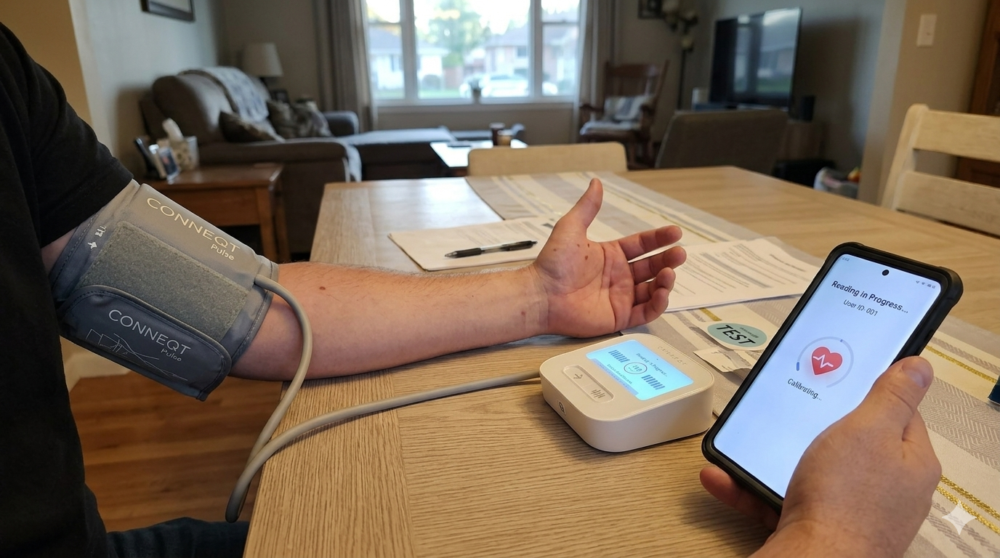
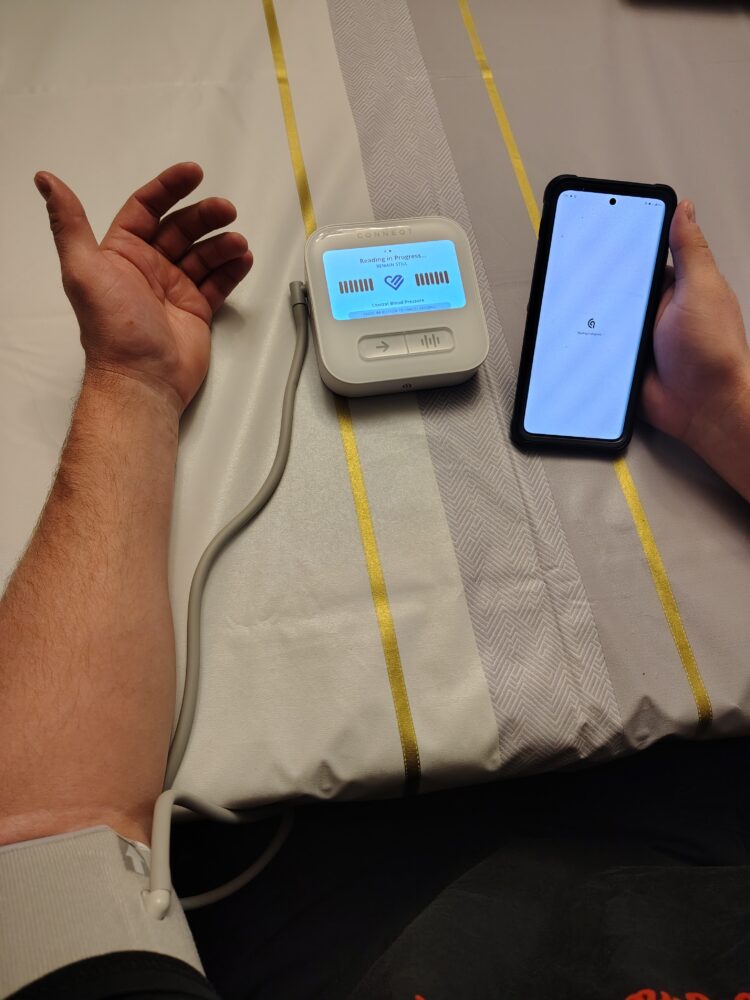
IMAGE: MedicalExpo’s select user, testing the product. Image retouched by Gemini.
Smartwatch vs. CONNEQT Pulse: Addressing the Patient Question
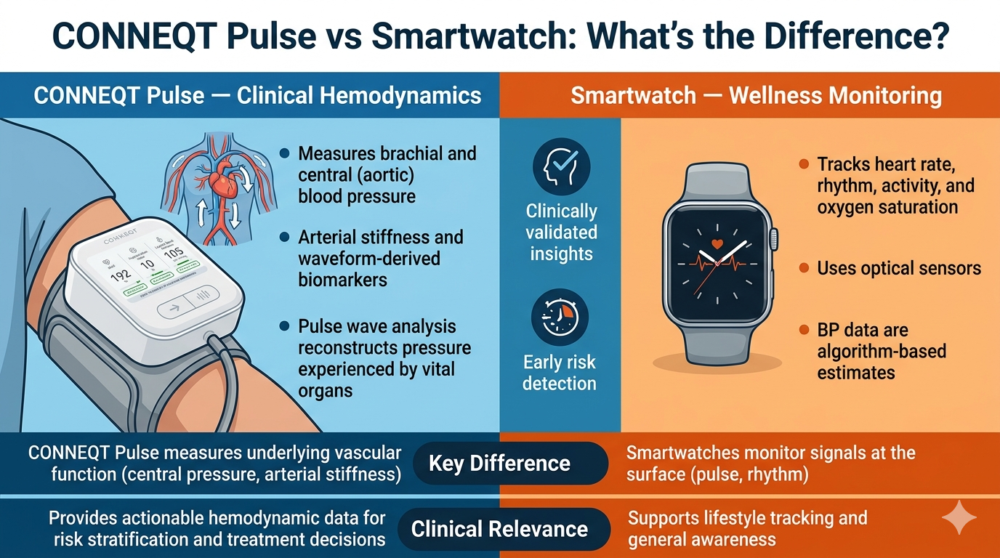
A central question raised during our in-house trial was whether CONNEQT Pulse offers meaningful advantages over widely adopted smartwatches. The comparison is intuitive, but physiologically misleading.
Consumer smartwatches primarily rely on photoplethysmography (PPG) to measure heart rate, rhythm, and oxygen saturation, with some offering algorithm-based blood pressure estimates. These devices monitor surface-level physiological signals and are designed for passive, continuous wellness tracking. They do not directly measure arterial pressure waveforms or central hemodynamics.
By contrast, CONNEQT Pulse analyzes arterial pressure waveforms to derive central blood pressure and vascular biomarkers. This enables assessment of:
- True cardiovascular load on vital organs
- Arterial stiffness and vascular aging
- Response to antihypertensive therapy
- Early or “hidden” cardiovascular risk
Due to pulse-wave amplification, peripheral blood pressure may not reflect central aortic pressure. Two patients with identical cuff readings can therefore present different hemodynamic burdens, a distinction that smartwatches are not designed to detect.
For clinicians, the value lies not in more frequent data but in more meaningful data.
Usability vs. Clinical Insight: A Real-World Trade-Off
The trial also highlighted an important limitation from the patient perspective. Unlike smartwatches, which passively collect data throughout the day, CONNEQT Pulse requires active user participation for each measurement.
For individuals without diagnosed hypertension or elevated cardiovascular risk, this distinction can reduce perceived utility. The device does not provide lifestyle-oriented metrics such as activity tracking or sleep analysis, and its benefits may not be immediately tangible.
In this sense, CONNEQT Pulse functions less as a lifestyle wearable and more as a portable diagnostic instrument. Its value emerges in specific contexts:
- Patients with hypertension
- Individuals with a family history of cardiovascular disease
- Therapy monitoring and medication titration
- Early detection of vascular dysfunction
This reinforces a broader point: devices like CONNEQT Pulse are not intended to replace consumer wearables, but to complement clinical care by extending hemodynamic assessment beyond the clinic.